












School Boards in India: Types and Differences
With the growing number of choices in this highly globalized world, many of us find it difficult to pick the right school board for our child. Most of us that the aim of imparting world-class education is highly dependent on our choice of school. And when it comes to instructional delivery or curriculum, the choice of the right school board plays a crucial role.
For many reasons, choices like the CBSE or the Indian Certificate of Secondary Education are highly preferred choices for parents in many parts of India. But again, these are only two of the many options out of the many. Because in the present Indian scenario, the board of education is not limited to these choices alone. In fact, Indian boards offer a wide variety of choices including truly world-class international boards as well.
In this write-up, we will cover the details of our education board, to help you make an informed choice. But first, let’s take you through an overview of the present condition of education in India.
Read on.
Statistical Information as per the Ministry of Education Government of India
General Details:
| Schools | Teachers | Students |
| 1489115 | 9507123 | 265235830 |
Drop-Out Rate:
| Level | Drop Out Rate |
| Primary | 1.45% |
| Secondary | 12.61% |

Gross Enrollment Ratio:
| Level | Gross Enrollment Ratio |
| Elementary | 100.13% |
| Secondary | 79.56% |

Pupil-Teacher Ratio:
| Level | Pupil-Teacher Ratio |
| Primary | 26.25 |
| Upper Primary | 18.86 |

Source– Department of School Education & Literacy, Ministry of Education, Government of India.
Most of us struggle to figure out which board of school is best for our child.
Let’s explore some relevant the details of education board. And decode this for ourselves.
Meaning of Different Indian Boards of Education?
Broadly, the education system in India categorizes boards as national, state, and international.
As per the Ministry of Education, Government of India, national boards fall directly under the Department of School Education and Literacy. On the other hand, a ‘Private National Board’ functions with approval from the concerned state/union territory government.
An international board is authorized by their respective authority to function in India. However, this approval is subject to the board’s eligibility as per the laws. And the legitimacy of the credential awarded by the particular board (should be at par with the qualifications awarded by Indian authorities).
How Many Prominent School Boards Are There in India?
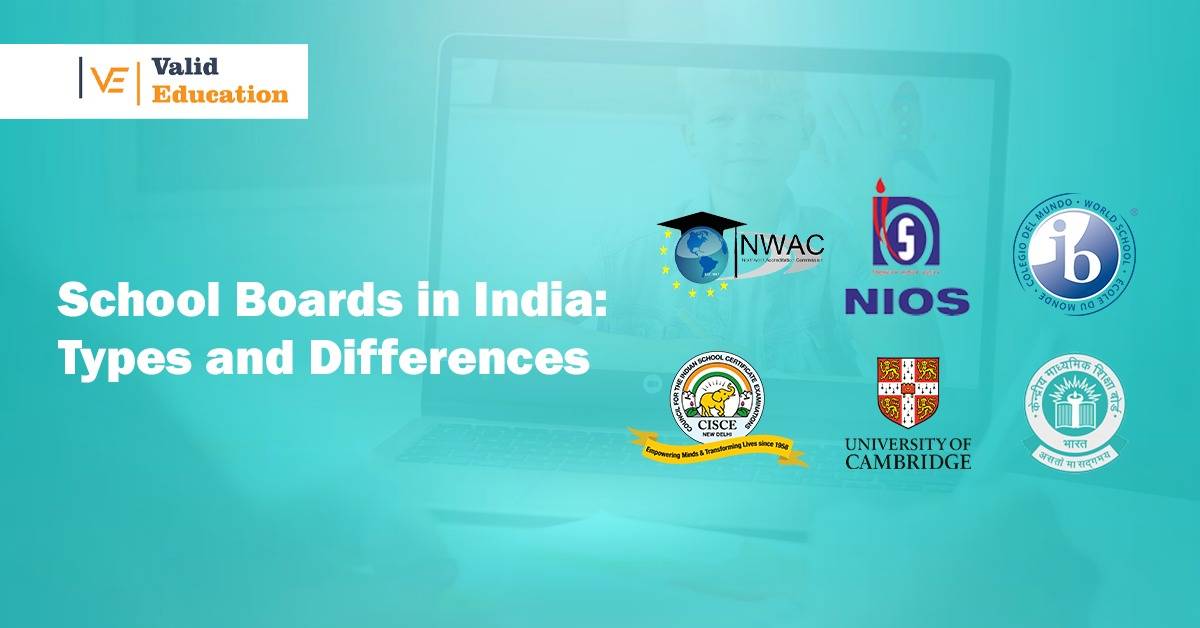
Mainly, school education in India is delivered through the following types of boards:
National Boards – CBSE (Central Board of Secondary Education) and NIOS (National Institute of Open Schooling).
Private National Board – CISCE (Council for the Indian School Certificate Examinations)
State Boards – Operational in different states of India
International Boards – IB (International Baccalaureate), Cambridge, NWAC, etc.
To sum it up, the Indian boards of education have 69 legitimate boards listed under the COBSE (Council of Boards of School Education). And this list also has 9 more international boards approved to function in India.

Here is the list of valid boards in India
Let’s explore the prominent boards individually to see how they are different from each other.
Central Board of Secondary Education (CBSE)
One of the most popular board of education in the Indian schooling system is the CBSE. This reputed national board has the following features:

- Pan India presence
- 24000 schools affiliated across India
- 240 school affiliations in 26 countries worldwide
- Follows the National Curriculum Framework 2005
- 211 subject choices
- Innovative pedagogy to work on knowledge and application
A survey proves that the students from the CBSE board perform better than the ones under state boards.
Here’s a look at the pros and cons of this board of education:
| S. No | Pros | Cons |
| 1 | Good Quality | Considered easy |
| 2 | Scope for extra-curricular activities | Too much emphasis on theory |
| 3 | Varied subject choices | Less focus on practical and experiential learning |
| 4 | Highly credible and accepted across India | |
| 5 | Easy to continue across different CBSE-affiliated schools | |
| 6 | Transparent procedures for students and stakeholders |
Let’s now move on to the next board now, the CISCE.
Council for the Indian School Certificate Examinations (CISCE)
With over 2750 affiliated schools, the CISCE is a prominent private national board that conducts three examinations namely:
- For class X– Indian Certificate of Secondary Education (ICSE)
- Class XII – Indian School Certificate Examination (ISC)
- Vocational Education – Certificate of Vocational Education Examination (CVE -12)
Notable Features of CISCE:
- Holistic curriculum
- Has affiliations in 5 countries
- 130 subject papers
- More than 29 states and union territories in CISCE India footprint.
- Focuses on building crucial skills like creativity, verbal and written communication, etc. right from the Indian Certificate of Secondary Education level.
- Integration of innovative technology to enhance the educational experiences.
- The ISC is recognized at par with the higher school qualification awarded by the University of Scotland.
Pros and cons of CISCE
| S. No | Pros | Cons |
| 1 | Amalgamates Indian values with the global vision | Lacks flexibility for parents who have transferrable jobs |
| 2 | Focus on building strong linguistic skills | Costs can be very high at times |
| 3 | Challenging curriculum | Students can find it difficult to pull off |
| 4 | Child-centric education | |
| 5 | Emphasis on life-skills | |
| 6 | Nurtures independent thinking, critical thinking and problem-solving |
National Institute of Open Schooling (NIOS)

Unlike the CBSE or Indian Certificate of Secondary Education examinations, the NIOS is an open school for students established under the Ministry of Education, Government of India. This one is not just a national board. But is also an integral part of the education system in India. The vision of this open school is to impart education to students who need more flexibility in their learning due to any condition/reason/needs/scenario.
The NIOS offers the below-mentioned programmes/courses:
Academic:
- Open Basic Education Programme (OBE which is equivalent to classes III, V and VIII)
- Secondary Education Course (equivalent to class X)
- Senior Secondary Education Course (equivalent to class XII)
Others:
- Vocational Educational Course
- Life Enrichment Programmes
A look at the features of NIOS:
- The largest open school in the world with over 2.71 million enrollments
- Ideal for non-traditional students
- 100% online admissions for classes 10th and 12th
- Credit transfer facility for up to 2 subjects from other boards
- 3324797 certified since the year 1991 (including secondary, senior secondary, and vocational)
- Ample learning support through the personal contact program
Pros and cons of NIOS
| S. No | Pros | Cons |
| 1 | At par with other recognized boards | Requires rigorous follow-up to track classes, centers, etc. |
| 2 | Fits in almost all types of students | Students can be casual with no stringent timetables |
| 3 | Focus on skill-building | Too much dependence on technology |
| 4 | Truly inclusive without any age limits | |
| 5 | A large number of study centers across the country | |
| 6 | Choice of the medium of instruction |
Now that we have discussed the secondary and primary education board types curriculum choices, etc. It’s time to move on to State boards.
State Boards
As the name suggests, state boards are run by the respective states for all levels of formal school education.
The top features of State boards are as follows:
- Region-specific education (school boards and features etc.)
- More focus on any local language and region-specific history
- Emphasis on the elements of the region’s cultural heritage
- Appropriate only for students who need not migrate to any state/international/Indian boards
Pros and cons of State Boards
| S. No | Pros | Cons |
| 1 | Good to understand the state’s history or culture | Not flexible with changing demands such as a location change |
| 2 | Ideal for students who need more time for extracurricular activities | Too much focus on mundane methods of teaching and learning |
| 3 | More affordable in many cases | Does not help students to be competitive in entrance examinations |
| 4 | Suits local residents | Not much focus on being updated with global needs |
| 5 | Focus on language understanding |

International Boards
By far, we have discussed many boards (from the primary education board to the senior secondary board). Let’s explore the choices of international boards now. The most popular choices amongst parents are IB i.e. International Baccalaureate and IGCSE i.e. International General Certificate of Secondary Education.
The features of these boards are summarized below:
- IB programmes are offered in around 5700 schools (159 countries). Similarly, the IGCSE has programmes in over 10,000 schools across more than 160 countries.
- In India IGCSE offers Cambridge International A Levels (equivalent to Indian senior secondary qualifications), Cambridge IGCSE, and Cambridge O Levels (5 Cambridge IGCSE or Cambridge O Level subjects including English Language are considered equivalent to class 10th in India)
- IB can be opted with a choice of Primary, middle, and diploma programs
- High-quality programs that focus on building new-age skill sets.
- Globally recognized as the best quality curriculums through the international board.
Pros and cons of International Boards
| S. No | Pros | Cons |
| 1 | Recognized across most universities globally | Expensive choice only for a few |
| 2 | Replaces CBSE and other boards seamlessly for students who wish to relocate/study abroad | Does not have any scope of shifting to Indian choices |
| 3 | High-quality education in every sense of the term | Many students might find it difficult to pull off |
| 4 | Quite reputed across the world |
Final Thoughts
We hope you are now aware of the prominent differences and features of the education board. A bit of advice before we wrap up, always focus on the child before you shortlist the right board. And remember your decision is crucial, as it’s a deciding factor with a make-or-break effect!
Thanks for Reading!
Frequently Asked Questions
- How many boards are there in school?
In India, there are different types of boards such as national, private national state, international, etc.
- Which board is used in school?
Most schools have a single board. However, some others have more than one board under the same institution, thereby giving more choices to the students.
- Which is the highest board in the school?
This depends on the choice of parents. In India, CBSE is believed to be highly reputed. But many parents also find international boards better for their child.
- Which board of school is best?
The choice of the right board of secondary education should be made basis the student’s needs, prospects of settling abroad, and family finances. Here’s a look at the top advantages of each board at a glance:
| CBSE | CISCE | NIOS | State Boards | International Boards |
| Good Quality | Amalgamates Indian values with the global vision | At par with other recognized boards | Good to understand the state’s history or culture | Recognized across most universities globally |
| Scope for extra-curricular activities | Focus on building strong linguistic skills | Fits in almost all types of students | Ideal for students who need more time for extracurricular activities | Replaces CBSE and other boards seamlessly for students who wish to relocate/study abroad |
| Varied subject choices | Challenging curriculum | Focus on skill-building | More affordable in many cases | High-quality education in every sense |
| Highly credible and accepted across India | Child-centric education | Truly inclusive without any age limits | Suits local residents | Quite reputed across the world |
| Easy to continue across different CBSE-affiliated schools | Emphasis on life-skills | A large number of study centers across the country | Focus on language understanding | |
| Transparent procedures for students and stakeholders | Nurtures independent thinking, critical thinking and problem-solving | Choice of the medium of instruction |
Suggested Read
- List of Valid Boards in India 2023-24
- List of Fake Boards in India 2023-24
- Why is Homeschooling Better Than Physical School
- Yoga for Kids: Discovering the Benefits and Fun of Yoga Poses
- Top 10 Best Schools in Guwahati 2023
- Top 10 Schools in Varanasi 2023
- Revolutionizing Education in 2023: The Rise of Online Education
- Top 10 Online Learning Platforms in India 2023